
Before your sofa reaches the truck, a typical apartment move-out can touch up to six areas that may be common property: the corridor, the lift, the main stairwell, the main entrance and foyer, the waste area and the car park. That count is our own, taken from the Tenants' Union's list of what common property can include. Your scheme's by-laws govern every one of those areas, and each scheme is different.
As we read it, the list of model by-law topics in the Tenants' Union strata factsheet covers obstruction of common property and vehicles but does not mention moving furniture or lift use. That suggests the detail for move day, such as lift bookings and hours, is most likely set by your own building.
So the answer is a short piece of homework before the truck is booked. Get a copy of your scheme's registered by-laws, then put eight questions to the strata manager. Our advice at Balmoral Removals is to do this before you lock in a date, not in the week of the move.
The path from your front door to the truck
Six stops, door to truck
- 1Corridor: can be common property.
Is protection required? - 2Lift: can be common property.
Does it need booking, and when? - 3Main stairwell: can be common property.
Is protection required? - 4Main entrance and foyer: can be common property.
What hours are moves allowed? - 5Waste area: can be common property.
What can be left here? - 6Car park: can be common property.
Where may the truck stand?
- Your apartment
- Can be common property
- Balcony: may also be common property
- The armchair by the lift (2)
- Or by the main stairwell (3)
Count of six areas is our own, from the Tenants' Union list.
Source: Tenants' Union of NSW
Follow one armchair out of the building and the questions write themselves. Common property can include main entrances and foyers, corridors, lifts, main stairwells, car parks and waste areas. Balconies, balustrades and structural walls may also be common property.
Inside your own apartment, the packing and carrying are yours to organise. Step into the corridor and you are on shared ground.
If your building has no lift, our walk-up apartment checklist covers the carry itself. This guide covers the rules around it.
Rules for moving out of an apartment: whose rules apply?
Who does what on move-out day
| Who | What |
|---|---|
| Registered by-laws | The rules all residents must follow, different in each scheme; changes are not enforceable until registered with NSW Land Registry Services. |
| Owners corporation | Gives owners a copy of the by-laws and must register by-law changes within six months of approving them. |
| Strata manager | Gives a copy of the by-laws. |
| Building manager (caretaker or resident manager), where the scheme has one | Controls use of common property and manages access for contractors. |
| Landlord or agent | Must give tenants the by-laws before the rental contract is signed; ask them for the building manager contact. |
Source: NSW Government; Tenants' Union of NSW
By-laws are the rules all residents in a strata scheme must follow, and each scheme has its own. Owners, tenants and buyers can get a copy from the owners corporation, strata manager or agent.
Two points decide whether a rule you are handed actually binds you.
The first is registration. Changes to by-laws are not valid or enforceable until registered with NSW Land Registry Services, and the owners corporation must register a change within six months of approving it.
The second is the rules sheet itself. Not every building rules sheet is binding: the Tenants' Union says “house rules” not registered as by-laws are not lawful.
That does not make the move-in, move-out sheet in your letterbox something to ignore. Ask whether it is a registered by-law or a booking procedure, then cooperate either way. A booking procedure is how neighbours share one lift and one loading area.
The person who runs the building day to day matters too. A building manager (caretaker or resident manager) controls the use of common property and manages access for contractors, so they are the one to tell when the truck is coming. Not every scheme has one.
Renting? How the by-laws reach tenants
When a tenant is owed strata documents
- Before the rental contract is signedA copy of the by-laws.
- Within 14 days of signingThe management statement (mixed-use buildings only).
- Within 14 days of a by-law change startingA new copy of the by-laws.
- Before move-outAsk the agent for the current by-laws and the building manager's contact.
The last step is our advice, not a rule.
Source: NSW Government
If you rent, strata rules are not only the owner's problem: the Tenants' Union says by-laws bind tenants and form legally binding terms of the tenancy agreement. A fine of up to $1,100 can be ordered against an owner or tenant (checked October 2026), and a breach can put the tenancy at risk.
Your route to the building runs through your landlord or agent. A tenant's agent or landlord must give them a copy of the by-laws before the rental contract is signed. In a mixed-use building, the management statement is due within 14 days of signing. If the by-laws change, a new copy is due within 14 days of the change starting.
Can't find your copy? Send the agent one email asking for the current by-laws and the building manager contact, since not every scheme has a manager on site.
What to do when moving out of an apartment: questions for the strata manager
Eight questions for the strata manager
Source: NSW Government; Tenants' Union of NSW
Send these to the strata manager, or to the building manager if your scheme has one. Ask in writing so the answers are on your phone on the day. None of them has a standard answer, which is exactly why they are worth asking.
- Can I have a copy of the registered by-laws, and the management statement if the building is mixed-use?
- Is the move-in, move-out sheet a registered by-law or a booking procedure?
- Does the lift need booking, and for which times?
- What hours are moves allowed?
- Is the loading area or car park shared, and where may the truck stand?
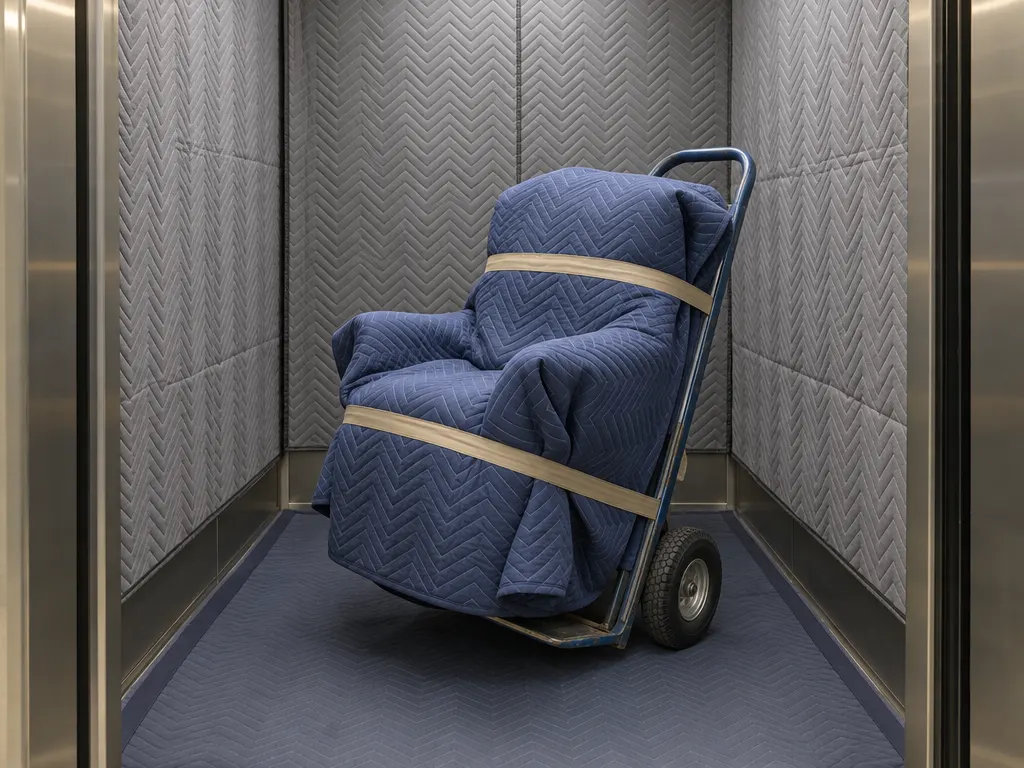
- Is protection required for the lift, corridors or walls?
- Who is the building manager or caretaker on the day, if there is one?
- Who is liable for damage to common property?
On hours, the NSW Government's advice on noise is to check the scheme's by-laws and local council rules for what noise is acceptable and when. A trolley in a tiled foyer at 7 am carries further than you think.
Where can the truck park in a strata building?
Who may park where in a strata car park
| Who | Where |
|---|---|
| Residents | Their own spaces only. |
| Visitors | Signed visitor spaces only; if no visitor parking is available, park elsewhere. |
| Removal truck | Ask the strata manager where it may stand. |
The owners corporation controls parking with signs, guards, key cards or barriers, and cannot issue parking fines itself; where council provides parking management, fines can apply as on public streets.
Source: NSW Government
Strata car parks are private property. Residents park only in their own spaces and visitors only in signed visitor spaces. If no visitor parking is available, the page says visitors should park elsewhere.
A removal truck is a large vehicle in a space built for cars. Ask the strata manager where it may stand rather than assuming a visitor bay is free for it. For the street side, see our guide to where the truck stands on a steep street.
An owners corporation controls parking with signs, guards, key cards or barriers. It cannot issue parking fines itself, but where council provides parking management, fines can apply as they do on public streets. A parking by-law breach can draw a tribunal penalty of up to $1,100, which can double if repeated within 12 months (checked October 2026).
What happens if a by-law is breached?
- Warning
- Notice to comply
- Fair Trading mediation (in certain cases)
- NCAT
Source: NSW Government
The NSW process runs from a warning, then a notice to comply, then Fair Trading mediation in certain cases, then NCAT.
The penalties climb at each step. NCAT can fine up to $1,100, then up to $2,200 for a continued breach, and up to $5,500 if a previous order was not followed (checked October 2026). On our arithmetic, ignoring an order can cost up to five times the first fine.
A move is one morning. A dispute over a gouged lift wall can outlast your time in the building. The questions above are cheaper.
Keep the building's booking with the removalist's paperwork
One folder for move day
Source: NSW Fair Trading; NSW Government
Two sets of paper decide who pays if something goes wrong: the building's and the removalist's. Keep the strata manager's written booking confirmation in the same folder as your removalist's quote. Before the day, ask both who is liable for damage to common property.
On the removalist side, NSW Fair Trading says to get a written, itemised quote. It should come with a contract listing the inventory, addresses, dates and times, how payment is made, and any extra costs for storage if there are delays.
Insurance is the gap people miss. Removalists are not required by law to insure your property, and most carry cover only for their vehicle. AFRA-accredited removalists have public liability insurance and can provide transit insurance. Our guide on checking a removalist's AFRA accreditation explains what that badge covers and what it does not.
Timing counts as well. A service must be provided with due care or skill, and within a reasonable time when none is set. What counts as reasonable depends on factors such as busy periods and public holidays.
If you are moving in the summer break, eastern-division summer school holidays run Friday 18 December 2026 to Wednesday 27 January 2027. Book the lift and the truck together, and early.
What happens to things left in the garage or storage cage?
Goods left behind in a strata building: what the owners corporation must do (checked October 2026)
| Left behind | What the owners corporation must do |
|---|---|
| Rubbish, food and plants | No notice. |
| Goods under $1,000 | Notice, then a 14-day wait. |
| Goods $1,000 to $20,000 | Written notice, then a 28-day wait. |
| Personal documents | Written notice, then a 28-day wait. |
| Goods over $20,000 | An NCAT order. |
Source: NSW Government
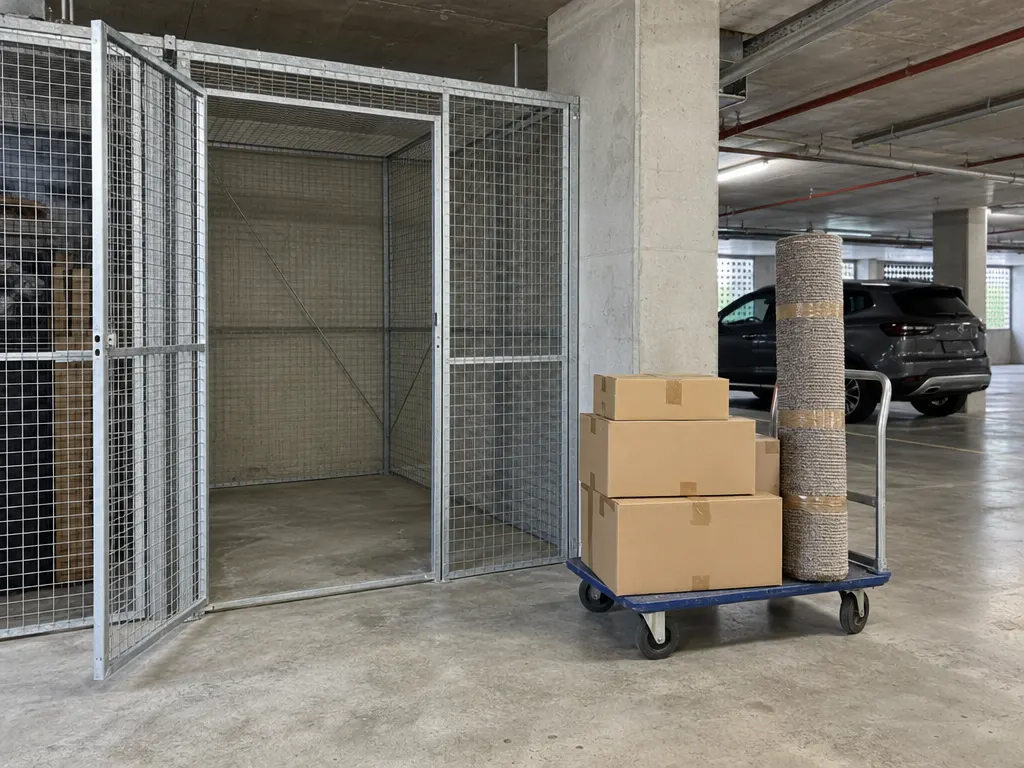
The garage shelf and the storage cage are where move-outs come undone. Left-behind goods on common property or in a lot are handled by the owners corporation, and the waits are set by the value of what you leave:
- Rubbish, food and plants need no notice.
- Goods under $1,000 need notice and a 14-day wait (checked October 2026).
- Goods between $1,000 and $20,000 need written notice and a 28-day wait (checked October 2026).
- Personal documents need written notice and a 28-day wait.
- Goods over $20,000 need an NCAT order (checked October 2026).
A forgotten bike can sit in the cage for weeks after you have handed back the keys. Walk the garage, the cage and the bin room before the truck leaves.
For the bulky things, many councils offer bulk kerbside or on-demand collection for items such as mattresses, old furniture and broken appliances, so check with yours.
In Mosman, the household clean-up takes up to 5 m³ per collection, but ask your strata manager whether your building is covered. Items go out only the night before and must not block footpaths, driveways or the road. It does not collect any item over 30 kg or with any side over 1.5 m, and it does not take e-waste, building waste or chemicals. A pre-paid extra clean-up needs 3 working days' notice and is limited to 4 a year per property.
Checklist when moving out of an apartment: the dates and limits in one place
The dates and limits in one place
Tenant by-law copy
Before the rental contract is signed.
www.nsw.gov.au/housing-and-construction/strata/living/by-laws
Management statement
Within 14 days of signing (mixed-use buildings).
www.nsw.gov.au/housing-and-construction/strata/living/by-laws
New by-law copy
Within 14 days of the change starting.
www.nsw.gov.au/housing-and-construction/strata/living/by-laws
By-law changes
Registered within six months of approval, and not enforceable until registered.
www.nsw.gov.au/housing-and-construction/strata/living/by-laws
NCAT fines
Up to $1,100; up to $2,200 for a continued breach; up to $5,500 if a previous order was not followed (checked October 2026).
www.nsw.gov.au/housing-and-construction/strata/living/by-laws
Parking by-law breach
Up to $1,100, can double if repeated within 12 months (checked October 2026).
www.nsw.gov.au/housing-and-construction/strata/living/parking
Abandoned goods
Under $1,000 notice and 14 days; $1,000 to $20,000 written notice and 28 days; personal documents written notice and 28 days; over $20,000 NCAT order (checked October 2026).
www.nsw.gov.au/housing-and-construction/strata/living/abandoned-goods
The key figures from this guide are gathered on one card, with their sources, so you can screenshot it and send it to whoever else is on the lease. The questions for the strata manager are in the checklist above. This card holds the deadlines and penalties.
Your next step
Once the strata manager has replied, you have what a removalist needs to quote properly. NSW Fair Trading says to give the removalist all the details about your move so the quote is accurate. Include the lift booking times, the permitted hours, the loading arrangements and where the truck may stand.
When you have those answers, request a quote from Balmoral Removals and paste them into your enquiry.
Sources
- https://www.nsw.gov.au/housing-and-construction/strata/living/by-laws
- https://www.tenants.org.au/factsheet-strata
- https://www.nsw.gov.au/housing-and-construction/strata/living/parking
- https://www.nsw.gov.au/housing-and-construction/strata/living/noise
- https://www.nsw.gov.au/housing-and-construction/strata/living/abandoned-goods
- https://www.nsw.gov.au/legal-and-justice/consumer-rights-and-protection/be-a-smart-consumer/choosing-a-removalist
- https://www.nsw.gov.au/about-nsw/school-holidays
- https://mosman.nsw.gov.au/residents/waste-and-recycling/household-clean-up
